
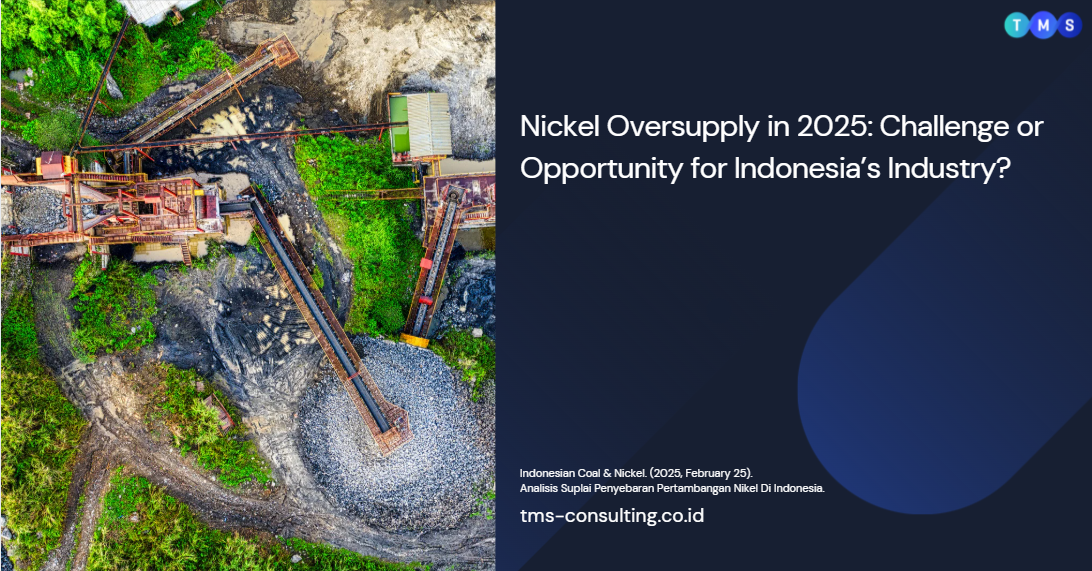
The global nickel market is projected to face a significant oversupply in 2025. According to the International Nickel Study Group (INSG), the market is expected to record a surplus of approximately 198,000 metric tons, as global primary nickel production reaches 3.735 million metric tons, exceeding estimated global consumption of 3.537 million metric tons.
This imbalance has placed sustained pressure on nickel prices. After declining by more than 7% throughout 2024, prices remained volatile in early 2025, falling to around US$15,000 per metric ton, the lowest level in nearly five years. As nickel remains a key input for stainless steel and electric vehicle (EV) batteries, these price movements reflect not only cyclical market dynamics but also structural shifts in global supply and demand.
For major producing countries such as Indonesia, the oversupply is not merely a market fluctuation it represents a strategic test of long-term competitiveness.
Nickel’s Evolution: From Stainless Steel to Energy Transition Mineral
Over the past two decades, nickel has evolved from a conventional stainless steel input into a critical mineral for the global energy transition. The rapid growth of electric vehicles and large-scale energy storage systems has elevated nickel’s role in clean energy supply chains.
Indonesia stands at the center of this transformation. With estimated reserves of approximately 55 million tons, representing nearly 40% of global nickel reserves, and annual production ranging between 1.8 and 2.2 million tons, the country has become the world’s largest nickel producer. However, abundant resources and strong investment inflows alone do not guarantee long-term resilience. Indonesia’s nickel industry is now shifting from a growth-driven boom toward a sustainability-focused phase that demands higher efficiency, stronger ESG compliance, deeper downstream integration, and readiness for future battery technology changes.
Ore Reserves and Production: Indonesia’s Natural Advantage
Indonesia’s nickel resources are primarily located in Sulawesi, Maluku, and parts of Papua, dominated by laterite ores that consist of saprolite and limonite types. Total ore resources are estimated at 5.3 billion tons, equivalent to around 55 million tons of contained nickel metal.
Production surged following the implementation of the nickel ore export ban and massive investments in smelter development. Between 2023 and 2024, Indonesia produced between 1.8 and 2.2 million tons of nickel, solidifying its position as the world’s leading producer. The emergence of downstream facilities producing nickel matte and Mixed Hydroxide Precipitate (MHP) signals a new phase of industrialization aligned with the EV battery value chain. Technologies such as Rotary Kiln Electric Furnace (RKEF) and High Pressure Acid Leach (HPAL) now play a critical role in transitioning the industry from stainless steel toward clean energy materials.
However, the dominance of investment and technology from a limited group of global partners introduces concentration risks that must be carefully managed.
Global Demand Outlook: EV Batteries Reshaping Nickel Consumption
While stainless steel remains the largest source of nickel demand globally, the battery segment is expanding rapidly. Benchmark Minerals projects that nickel demand for batteries could reach 1.5 million tons by 2030, accounting for more than 50% of total demand growth over the decade.
Other studies suggest that the share of nickel used for batteries will increase from 8% in 2022 to approximately 18% by 2030. In parallel, the International Energy Agency (IEA) forecasts global battery demand to grow 4.5 times by 2030 compared to 2023 levels. These trends underscore the strategic importance of positioning Indonesia not just as a volume producer, but as a value-added supplier within the energy transition ecosystem.
Indonesia’s Strategic Opportunity Amid Global Competition
Geographically, Indonesia is well-positioned near major EV manufacturing hubs in China, South Korea, and Japan. This proximity offers logistical advantages and significant opportunities for industrial partnerships. The availability of low-grade laterite ores further strengthens Indonesia’s position, particularly when combined with HPAL technology that enables the production of high-value materials such as MHP and nickel sulfate.
Key Strategies: Efficiency and Operational Excellence
In an environment characterized by price volatility and potential oversupply, operational excellence becomes a strategic imperative. Improving recovery rates, reducing energy intensity, and increasing smelter throughput allow producers to enhance capacity while maintaining cost competitiveness.
The adoption of digital mining and digital plant solutions including real-time sensors, predictive maintenance, and integrated mine-to-plant data, enables faster, data-driven decision-making. When combined with strong safety culture and workforce capability development, these initiatives strengthen supply reliability and reinforce Indonesia’s reputation as a resilient global partner.
Conclusion: Partnering for Sustainable Transformation with TMS Consulting
As global nickel markets face oversupply, price volatility, and accelerating energy transition demands, Indonesia’s nickel industry stands at a critical crossroads. Long-term competitiveness will no longer be driven by scale and production volume alone, but by the ability to operate efficiently, plan adaptively, and deliver higher-value downstream outcomes with strong governance and sustainability standards.
TMS Consulting supports mining and metals companies in navigating this transition through integrated digital transformation initiatives. With deep experience in SAP-based enterprise integration, Anaplan-driven scenario planning, and Planview-enabled portfolio and investment governance, TMS Consulting helps organizations connect operational data, financial planning, and strategic execution into a single, coherent framework.
By aligning technology, process, and people, TMS Consulting enables nickel producers to strengthen cost control, improve decision-making agility, and ensure that downstream investments remain aligned with long-term business objectives. In an increasingly complex and competitive global landscape, this integrated approach allows companies not only to respond to market volatility, but to build resilient, sustainable, and future-ready operations in support of the global energy transition.
References :
Indonesian Coal & Nickel. (2025, February 25). Analisis Suplai Penyebaran Pertambangan Nikel Di Indonesia.